
kezhiding kezhiding

What Is the Best AC to AC Voltage Controller?

Time:2026-10-24 Author:Sienna
0%

Choosing the best ac to ac voltage controller is not simply a matter of selecting the highest power rating. The right device must match the load, supply frequency, control method, thermal environment, and required voltage stability. A controller used for a small induction motor behaves differently from one driving a heater bank or transformer.

Ned Mohan, a respected power electronics professor and author, defines the field clearly: “Power electronics is the technology associated with the efficient conversion, control, and conditioning of electric power.” That principle guides this comparison. An ac to ac voltage controller should regulate power efficiently while limiting waveform distortion, electrical noise, overheating, and unnecessary stress on connected equipment.

Look closely at the details. A workshop motor may need soft starting and reduced inrush current. A heating element may prioritize smooth power adjustment. Sensitive equipment may require tighter regulation and lower harmonic disturbance. Semiconductor type matters too. TRIAC-based controllers are common and economical, while IGBT or advanced digital designs may provide finer control.

There is no universal winner.

Even experienced engineers can choose poorly when they focus only on price or rated current. Real installations include long cables, dusty cabinets, fluctuating mains, and imperfect cooling. These factors change performance.

This guide compares controller architectures, load compatibility, efficiency, control accuracy, protection features, installation demands, and total operating cost. It also identifies where common assumptions fail, helping readers select an ac to ac voltage controller based on measured requirements rather than marketing claims.
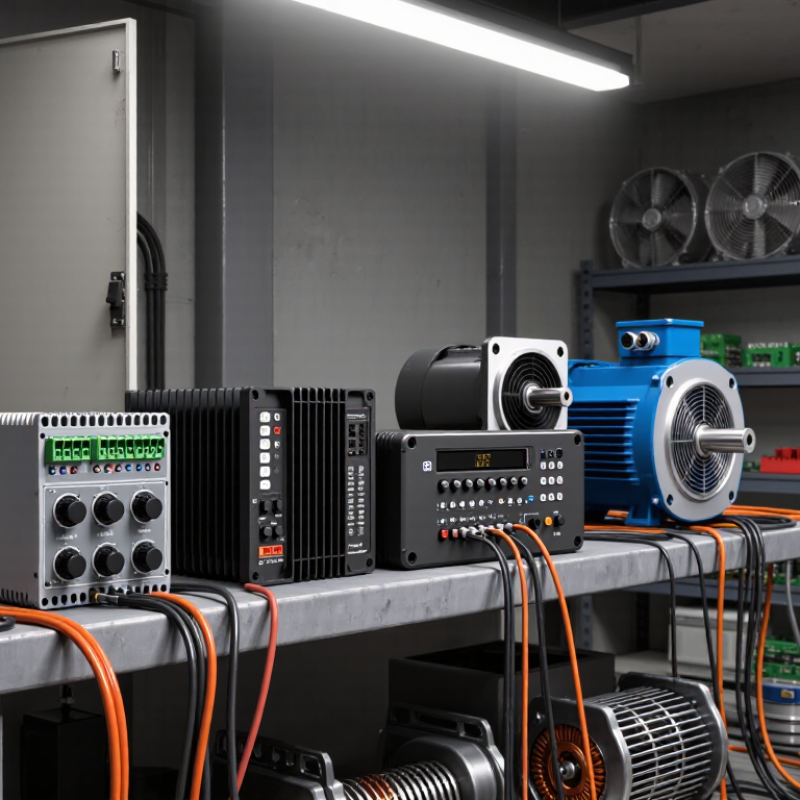
What Is the Best AC to AC Voltage Controller?

How AC-to-AC Voltage Controllers Work

What Is the Best AC to AC Voltage Controller?

An AC-to-AC voltage controller adjusts an alternating supply without converting it into a stable DC link. Semiconductor switches, such as thyristors, turn on at selected points in each AC cycle. Delaying the firing angle reduces the voltage delivered to the load. The output remains alternating, but its waveform becomes less smooth.

How AC-to-AC Voltage Controllers Work

During practical testing, a resistive heater responds predictably because its current follows the voltage waveform. A motor is more demanding. Phase-angle control can create harmonics, audible noise, torque pulsation, and electromagnetic interference. Integral-cycle control offers cleaner switching for some heating applications, but it may cause visible power fluctuations under certain conditions. Small details matter.

The best AC-to-AC voltage controller depends on the load, power rating, frequency, and control method. Check the true RMS current, not only the stated wattage. Provide suitable heat dissipation and protection against overcurrent. I would also inspect the waveform with an oscilloscope during commissioning. A controller can appear stable while producing unwanted peaks. That is easy to miss. For sensitive equipment, filtering and electrical isolation may be necessary. One limitation deserves honest attention: no controller removes every harmonic problem. Better design reduces the risk, but real loads often behave differently from calculations.

Main Types of AC-to-AC Voltage Controllers

What Is the Best AC to AC Voltage Controller?

The best AC-to-AC voltage controller depends on the load, switching noise limits, and required control accuracy. Phase-angle controllers use thyristors to cut each AC waveform. They provide smooth RMS-voltage adjustment for heating elements, lamps, and some universal motors. However, waveform distortion can create harmonics, audible noise, and electromagnetic interference. IEC 60947-4-3 highlights the importance of correct semiconductor switching and thermal protection in these applications.

Integral-cycle controllers, also called burst-fire controllers, switch complete AC cycles on and off. They are well suited to ovens, infrared heaters, and other slow thermal loads. Switching near the zero crossing reduces electrical stress and usually produces cleaner operation. The trade-off is visible power fluctuation when the load responds quickly. It is easy to underestimate this issue.

Transformer-based controllers adjust voltage without chopping the waveform. They offer strong isolation and low distortion, but they are heavier and less flexible. Cycloconverters and matrix converters belong to a broader AC-to-AC conversion family. They can control voltage and frequency, yet their cost and design complexity often exceed ordinary voltage-control needs. The IEA Electricity 2024 report projects global electricity demand growth of about 4% in 2024 and 2025, increasing attention on efficient motor and heating control. In practice, engineers should measure RMS voltage, load current, temperature, and harmonics before choosing. A controller that looks efficient on paper may perform poorly with an unstable or highly inductive load.

Key Performance Factors to Compare

What Is the Best AC to AC Voltage Controller?

The best AC to AC voltage controller depends on the load, not its advertised power rating. For heaters, lamps, and induction motors, compare output stability, efficiency, harmonic distortion, response speed, and overload capacity. The International Energy Agency estimates that electric motor systems use about 53% of global electricity. Even small control losses can therefore become expensive across factories.

Efficiency should remain high at partial load, where many controllers operate most of the day. Check the manufacturer’s test conditions carefully. A claimed 98% efficiency may apply only near full rated power. Total harmonic distortion also matters. Excessive harmonics can increase motor heating, audible noise, and nuisance protection trips. IEEE 519 provides widely used guidance for harmonic control, although its limits depend on the installation point. Thermal design deserves equal attention. Measure enclosure temperature after several hours, not after five minutes.

Tips: Compare regulation accuracy at 25%, 50%, and 100% load. Request oscilloscope waveforms, thermal test records, and independent compliance reports. Select a controller with adjustable ramping for motor loads. Keep a safety margin above the measured starting current. A model that looks oversized may actually run cooler and last longer. Yet oversizing can reduce control precision, so this choice needs testing. The U.S. Department of Energy’s motor-system guidance also emphasizes matching controls to actual operating conditions, rather than relying on nameplate ratings alone.

How Load Type Affects Controller Selection

What Is the Best AC to AC Voltage Controller?

How Load Type Affects Controller Selection

The best controller depends on the load, not its advertised power rating. Resistive heaters are the easiest match. Their current follows voltage closely, so phase-angle control can adjust heat smoothly. The IEA’s Electric Motor Systems Annex estimates that motor-driven systems consume about 46% of global electricity. Small selection errors therefore create meaningful losses. Start with the load.

Induction motors need more caution. Lowering voltage reduces torque sharply and may increase slip, noise, and winding temperature. A fan or centrifugal pump can tolerate voltage control when speed changes remain modest. Constant-torque machinery usually needs a frequency converter instead. The U.S. Department of Energy’s Industrial Motor Systems Market Opportunities Assessment reports that motor systems represent roughly 70% of industrial electricity use. That figure makes efficiency and thermal testing difficult to ignore. In commissioning work, a motor may run quietly while still overheating. The waveform matters.

Transformer and capacitive loads create different risks. A transformer can saturate under distorted waveforms, causing inrush current and audible hum. Capacitive inputs may produce unstable current peaks. Check the controller’s minimum load, firing method, current rating, and compatibility limits. IEC 61000-3-2 provides useful guidance on harmonic current emissions, although compliance alone does not guarantee reliable operation. I would also measure RMS current, power factor, and temperature at full load. A laboratory result can mislead when cable length, ventilation, or starting conditions change. The “best” choice is sometimes a less flexible controller with cleaner output.

How to Choose the Best AC-to-AC Voltage Controller

Choosing the best AC-to-AC voltage controller starts with the load, not the catalog rating. Identify the supply voltage, phase arrangement, frequency, running current, and startup surge. A resistive heater usually accepts phase-angle control well. An induction motor needs careful compatibility checks because its inrush current and inductive behavior can stress the controller. A controller rated only slightly above the normal current may fail during repeated starts.

Examine the output waveform and control method. Phase-angle control offers smooth adjustment but can create harmonics, electrical noise, and motor vibration. Integral-cycle control may suit heating loads better, especially when precise temperature control matters. Check whether the input signal matches your system, such as manual potentiometer, analog voltage, or digital command. Small details matter here. A control panel may appear stable while the load responds poorly.

Thermal performance deserves direct attention. Confirm the continuous current rating at the real enclosure temperature, not only at laboratory conditions. Review cooling clearance, heat-sink requirements, short-circuit protection, and over-temperature behavior. An oversized controller is not automatically the best choice. It may cost more, occupy valuable space, and still need proper ventilation. I have seen selection sheets ignore startup conditions and cable length, which later caused nuisance trips. Verify applicable electrical standards and installation requirements before commissioning, then test the controller under the actual load.

What Is the Best AC to AC Voltage Controller? - How to Choose the Best AC-to-AC Voltage Controller

Controller Type Control Principle Typical Load Compatibility Output Control Range Waveform and Harmonics Main Advantages Main Limitations Best Application
Single-Phase Phase-Angle Controller Adjusts the firing angle of bidirectional semiconductor switches during each AC half-cycle. Resistive heaters, incandescent lamps, and some universal-motor loads. Typically adjustable from near 0% to approximately 100% of rated RMS voltage, depending on the circuit and load. Non-sinusoidal output with increased low-order harmonics and electromagnetic interference at reduced output levels. Compact design, fast response, continuous control, and relatively low component count. Can create audible noise, power-factor reduction, supply distortion, and motor heating if the load is unsuitable. Low-cost power adjustment for heaters, lamps, and compatible small motors.
Three-Phase Phase-Angle Controller Controls the conduction angle of semiconductor devices in a three-phase AC circuit. Three-phase heating systems, compatible induction motors, and industrial AC loads. Commonly provides continuous RMS-voltage adjustment across a broad operating range within the rated input voltage. Produces waveform distortion and harmonics; balanced firing and suitable filtering are important. Suitable for higher power levels and three-phase loads; provides smooth voltage adjustment. More complex gate control, greater harmonic current, and possible motor torque pulsation. Industrial heating and approved three-phase loads requiring continuous adjustment.
Integral-Cycle Controller Connects or disconnects complete AC cycles, usually at a controlled repetition rate near a zero-voltage crossing. Thermal loads with relatively slow temperature response, such as ovens and furnaces. Average power is controlled by the ratio of conducting cycles to non-conducting cycles rather than by chopping each cycle. Lower switching transients than phase-angle control, but the supply experiences cyclic power variation and possible flicker. Low switching loss, reduced high-frequency interference, and near-zero-crossing operation. Not suitable for fast-response loads, lighting where flicker is unacceptable, or applications needing instantaneous voltage control. Industrial and commercial electric heating with thermal inertia.
AC Chopper Controller Uses high-frequency switching to synthesize a variable AC output from the AC input. Specialized motor drives, power-conversion systems, and applications requiring improved controllability. Can provide a wide adjustable output range, subject to the switching topology, filter design, and rated voltage. Switching-frequency components are present; input and output filters may be required to meet EMC limits. Potentially better input power factor and waveform performance than basic phase-angle control when properly designed. Higher circuit complexity, switching losses, thermal-management requirements, and control cost. Advanced systems where waveform quality, dynamic response, or compact conversion is important.
Variable Autotransformer Controller Changes the AC voltage through a mechanically adjustable transformer tap or sliding contact. Resistive loads, laboratory equipment, testing systems, and loads requiring a clean sine wave. Often adjustable from 0 V to approximately the input voltage, or slightly above input voltage in step-up configurations. Preserves a near-sinusoidal waveform and introduces very little switching distortion. Excellent waveform quality, low electrical noise, and straightforward voltage adjustment. Large and heavy, has moving parts, provides no inherent electrical isolation, and may be unsuitable for rapid changes. Manual laboratory adjustment and sensitive loads where waveform purity is more important than compact size.
Transformer-Tap Voltage Controller Selects fixed transformer taps using switches, contactors, or semiconductor devices. Equipment that can operate with discrete voltage settings and loads requiring electrical isolation. Provides several predetermined voltage levels rather than continuously variable output. Generally maintains a sinusoidal waveform, with switching transients depending on the tap-changing method. Can provide galvanic isolation, robust operation, and good voltage regulation at selected steps. Limited resolution, larger size, audible transformer noise, and possible transient voltage during tap changes. Fixed-step voltage correction, isolation applications, and robust industrial installations.

Selection should be based on input voltage and frequency, single-phase or three-phase operation, load type, rated current, required adjustment speed, waveform quality, power factor, cooling, protection, and applicable electrical-safety and electromagnetic-compatibility requirements. The stated ranges are typical design characteristics, not universal ratings.

FAQS

What is the best AC-to-AC voltage controller?

The best choice depends on the load, waveform limits, and control accuracy. Start with the load. Measure RMS voltage, current, temperature, and harmonics before choosing.

When is phase-angle control suitable?

Phase-angle control suits resistive heaters, lamps, and some universal motors. It adjusts RMS voltage smoothly. However, waveform cutting can create harmonics, noise, vibration, and electromagnetic interference.

When should integral-cycle control be used?

Integral-cycle control suits ovens, infrared heaters, and slow thermal loads. It switches complete AC cycles near zero crossing. This reduces switching stress, but visible power changes may affect fast-reacting loads.

Can an AC voltage controller control an induction motor?

Sometimes, but caution is necessary. Lower voltage reduces torque and may increase slip, noise, and winding temperature. Fans and centrifugal pumps may tolerate modest changes. Constant-torque machinery usually needs frequency control instead.

Why does the load type matter so much?

Resistive loads usually follow voltage changes predictably. Transformers may saturate under distorted waveforms. Capacitive inputs can create unstable current peaks. A controller can look suitable while the load overheats.

What electrical details should be checked before selection?

Check supply voltage, phase arrangement, frequency, running current, and startup surge. Confirm the minimum load and current rating. A controller rated slightly above normal current may fail during repeated starts.

How important are cooling and enclosure conditions?

They are critical for reliable operation. Check continuous current at the actual enclosure temperature. Allow space around the heat sink. Confirm ventilation, short-circuit protection, and over-temperature behavior.

Can a laboratory test guarantee field performance?

No. Cable length, ventilation, startup conditions, and load instability can change results. A paper calculation can mislead. Test the controller under the actual load before commissioning.

Conclusion

Choosing the best ac to ac voltage controller depends on how accurately, efficiently, and safely it can regulate alternating-current power for a specific application. These controllers adjust the output voltage by controlling the timing or waveform of the input AC supply. Common types include phase-angle controllers, integral-cycle controllers, and transformer-based solutions, each offering different advantages in response speed, control precision, noise, and efficiency.

When comparing options, consider voltage and current capacity, adjustment range, switching performance, heat dissipation, electromagnetic interference, reliability, and protection features. The load type is equally important: resistive loads may require simple and stable regulation, while inductive or motor loads need smoother control and stronger compatibility with starting and changing power demands. To select the right controller, define the application’s electrical requirements, operating environment, control method, and long-term performance goals, then choose a design that provides dependable regulation without unnecessary complexity.

Sienna

Sienna

Sienna is a skilled marketing professional with a deep expertise in our company’s core products and services. With a passion for innovation and detail, she plays a pivotal role in crafting insightful blog posts that not only highlight the unique features of our offerings but also provide valuable......